
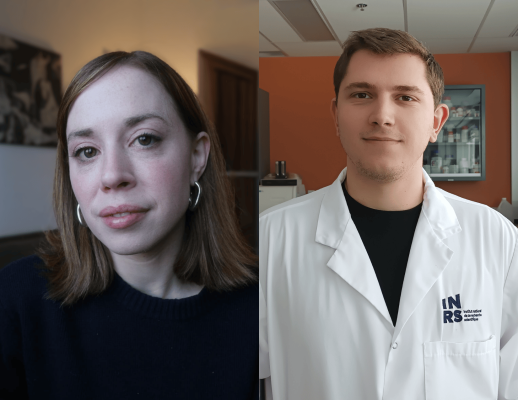
Since 2025, the INRS Foundation’s reproductive health scholarships have supported projects that shed light on critical issues in women’s health. This year, the grants are being awarded to Anne Catherine Archambault Morneau (Rita-Henry Breault Scholarship) and Sidney CALËN (Suzanne-Parenteau Scholarship) thanks to the generosity of the Rita Henry-Breault and Gilles Breault Foundation.
These grants are designed to support emerging scientists whose work helps advance knowledge in reproductive health and deepen our understanding of the biological, social, and environmental issues related to it.
Recipient of the Rita-Henry Breault Scholarship
As a doctoral student studying the care trajectories of young women living with polycystic ovary syndrome (PCOS), Anne Catherine Archambault Morneau takes a social science approach to better understand their lived experience—from the onset of initial symptoms to receiving a diagnosis and beyond. Her project highlights the social, informational, and symbolic dimensions that shape understandings of the body and reproductive health.
Anne Catherine Archambault Morneau, Ph.D. student in interdisciplinary program in health and society under the supervision of Professor Laurence Charton
- What led you to INRS? What stands out to you about your experience?
I first learned about INRS through my undergraduate research internships. I had the opportunity to work on some very stimulating research projects, including one led by Professor Laurence Charton, which focused on the use of a mobile app by couples trying to conceive. Through this experience, my interest in this field of study solidified. It then became clear to me that I wanted to pursue a master’s degree and, this time, explore the use of these digital tools in young women’s contraceptive practices. This experience was particularly pivotal in my career path. I am very grateful for the professional and academic opportunities I was offered, as well as for the connections I was able to forge with the INRS community—aspects that make my experience even more enriching. - Can you describe the significance and impact of your research project?
I’m interested in the care pathways of young women living with polycystic ovary syndrome (PCOS). Numerous studies highlight the difficulties involved in obtaining a diagnosis, particularly because the first symptoms appear during adolescence and are often mistaken for changes associated with puberty. The prescription of birth control pills—frequently used to regulate menstrual cycles or treat acne—can also mask certain indicators of the syndrome. My dissertation project aims to analyze, from a life course perspective, how young women in Quebec living with PCOS make sense of their bodily experiences before, during, and after diagnosis. By studying their testimonies and the educational strategies they employ to understand their condition, I hope to gain a better understanding of social representations of the body in the context of PCOS. - What does winning this scholarship mean to you?
This scholarship holds special significance for me. It recognizes several years of dedication to a field of research that fascinates me and reaffirms the relevance of the questions that drive me. It also gives me the momentum I need to continue my research as a doctoral student. - How do you see things moving forward?
While working on my dissertation, I hope to develop tools for knowledge transfer in reproductive biology, using an interdisciplinary approach and in collaboration with professionals who work with young people. For me, this is a way to make research more accessible and more relevant to real-life experiences.
Recipient of the Suzanne-Parenteau Scholarship
A master’s student in biology, Sidney Calën is interested in the impact of environmental pollutants on reproductive health. His research focuses specifically on endocrine disruptors found in cosmetics and on the risks associated with increased exposure among women working in the personal care industry.
Sidney Calën, Master's student in Experimental Health Sciences under the supervision of Professor Isabelle Plante
- What brought you to INRS? What stands out to you about your experience?
I went to INRS during my bachelor’s degree in France as part of an internship. I was immediately drawn to the research topic of Professor Isabelle Plante’s lab, which focuses on the impact of environmental pollutants on mammary gland development and breast cancer risk. I also got to know the scientific research community in Quebec, which I really enjoyed. That’s why I left France to pursue my master’s degree at INRS. - Can you describe the significance and impact of your research project?
Endocrine disruptors are molecules that disrupt the endocrine system and can cause reproductive disorders, cancers, or metabolic diseases. They are found in large quantities in cosmetic products. My project aims to study exposure to endocrine disruptors among women working in the personal care sector (hairdressers, estheticians), who are more exposed than the general population. The goal is to explore the link between this high level of exposure and an increased risk of breast cancer, with the ultimate aim of contributing to the implementation of appropriate preventive measures. - What does winning this grant mean to you?
This grant is a wonderful recognition of the work I’ve done and the work I’ll be doing. It will allow me to conduct further experiments and tests to assess the role of endocrine disruptors in the risk of developing breast cancer. - What are your plans for the future?
I plan to complete my master’s degree in 2027 and go on to pursue a Ph.D. in biology, focusing on environmental pollutants and carcinogenesis.
Congratulations to our two students on this well-deserved recognition, and a big thank you to the Rita Henry-Breault and Gilles Breault Foundation for its generosity and commitment to supporting research projects that contribute to a better understanding of reproductive health issues and to improving prevention, diagnosis, and care practices.
The Foundation also acknowledges the support of the Office of Academic Affairs and Student Success in administering the competition and selecting the candidates.