
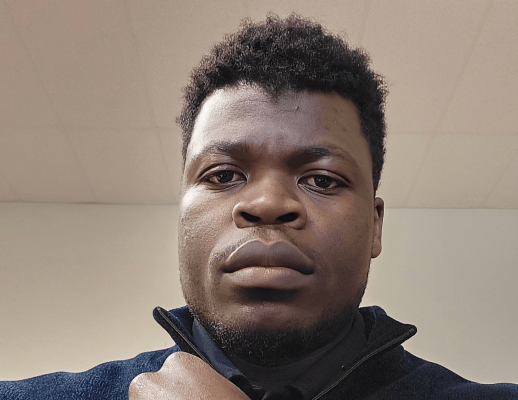
Congratulations to Therry Ngounnoun Tenkeu, the new recipient of the Career Transition Scholarship, which recognizes atypical academic and professional backgrounds and highlights the courage to return to school in order to give new momentum to one's career.
With a master's degree in computer science, Therry began his career as an information systems technician and consultant before making his first transition to water engineering. For more than eight years, he worked in the planning, management, and supervision of drinking water networks and sanitation facilities, notably in collaboration with municipalities and engineering companies.
Faced with issues related to access to water and sanitation, which he considers to be major challenges for public health and sustainable development, he decided to return to school at INRS to strengthen his scientific foundations and deepen his skills in modeling, geographic information systems, and environmental management, while familiarizing himself with Canadian and Quebec standards.
Therry Ngounnoun Tenkeu, student in the professional master's program in water and sanitation under the supervision of Professor Paul Célicourt
- What brought you to INRS? What have you gained from your experience?
My professional background has led me to work at the intersection of computer science, information systems, and issues related to water and infrastructure. Wanting to explore this convergence further and give my skills a more concrete and regional focus, INRS was the natural choice. The professional master's degree in water sciences offers a unique, interdisciplinary, and applied framework that combines scientific rigor with operational responses to real-world issues. What I remember most about my experience at INRS is the quality of the teaching, the richness of the exchanges with researchers and practitioners from various disciplines, and the freedom given to develop projects rooted in major societal issues. This training allows me to consolidate my profile as a hydroinformatician, combining water engineering, geomatics, and digital tools to promote regional resilience and infrastructure management. - Can you describe the challenge and impact of your research project?
My project focuses on extreme rainfall and flood risk in Montreal, which pose a growing threat to public transportation infrastructure. The central issue is to understand how to make these networks more resilient, while improving coordination between the many stakeholders involved (transportation, water management, civil security, municipalities). In this context, my mandate is to set up a geovisualization platform for flood risk that is shared among partners. This platform aims to centralize, analyze, and visualize hydrological, geospatial, and infrastructure data to support decision-making, both in planning situations and during extreme events. The expected impact is twofold: to improve the anticipation of flood-related disruptions and to strengthen information sharing between stakeholders, which is essential for effective and coordinated risk management. - What does winning this scholarship mean to you?
Winning this Career Transition Scholarship is a very important recognition of my unusual career path and my commitment to returning to school to study concrete, current issues. It provides both valuable financial support and strong moral encouragement, which reinforces my decision to pursue this career change. This scholarship allows me to devote myself fully to my project, deepen my skills, and strive for high-quality work, while promoting the link between technical expertise, applied research, and social utility. I also see it as a strong signal of the importance that INRS places on diversity of backgrounds and interdisciplinary innovation. - How do you see things progressing from here?
In the short term, I want to finalize this project by producing concrete, transferable tools that can be used by transportation stakeholders such as the Société de transport de Montréal (STM) and risk management professionals in Montreal. In the medium and long term, I aim to develop a decision-making tool for the sustainable and efficient management of urban transportation infrastructure, which I will propose to the STM, and to pursue a career as a hydroinformatician (interface between computer science, water management, geomatics, and urban infrastructure), whether in the public or parapublic sector or in collaboration with research organizations. My goal is to actively contribute to the development of digital and decision-making solutions that promote the resilience of cities in the face of climate change, by putting my skills as a water science professional and computer scientist at the service of territorial adaptation.
For Therry Ngounnoun Tenkeu, the career transition grant represents much more than financial support; it is recognition of the value of his career to date and his commitment to putting his expertise to work in the service of sustainable solutions. It will allow him to devote himself fully to his work and actively contribute to his research at the Centre Eau Terre Environnement, with the ambition of helping to improve water and sanitation systems, both in Quebec and internationally.
By awarding this $5,000 scholarship, the INRS Foundation reaffirms its commitment to supporting educational paths marked by diversity of experience, perseverance, and a desire to have a tangible impact on societal issues.
The Foundation warmly thanks its donors for their generosity and the Graduate Studies and Student Success team for its support in administering the competition.